Introduction
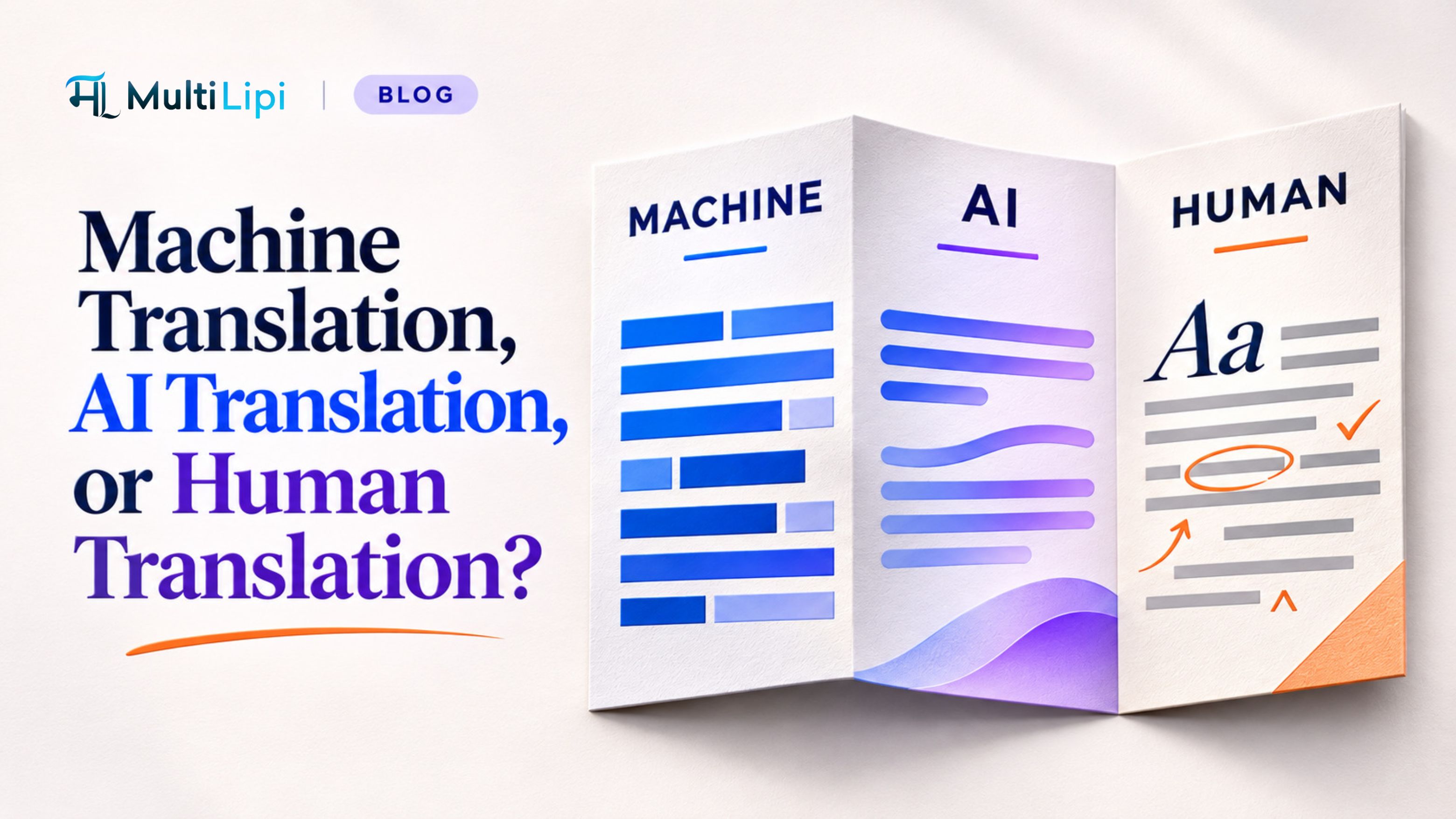
Machine translation, AI translation, and human translation all move text between languages, but they work in very different ways. Knowing the difference helps you choose the right approach for your website.
Machine translation is software that converts text automatically. It began with rule-based systems and statistical models, and it recognizes word patterns without truly understanding meaning. The output is fast, but it can sound stiff.
AI translation goes further. It uses generative AI and language AI to interpret context, learn from human feedback, and adapt tone. Most modern AI translation is built on neural machine translation (NMT), which uses neural networks to read a whole sentence at once rather than word by word.
Human translation is done by professional linguists. They bring cultural nuance, industry expertise, and creative judgment that software still struggles to match.
Why the labels get mixed up
Most "translated by AI" labels do not mean what you think. Many tools still run on traditional machine translation engines.
Modern machine translation is already AI. Neural networks power most of it, so the terms overlap.
One English headline, three translation workflows
Take one line: "Make every market feel like home." Run it through three workflows and you get three different results.
- Machine translation: a fast first draft.
- AI translation: a draft shaped by context, tone, and instructions.
- Human translation: a version checked for cultural nuance and brand intent.
These approaches often work together in one workflow.
At MultiLipi, we see this daily on websites. Below, we compare the three on speed, cost, accuracy, and context handling.
For a complete multilingual customer journey, translation quality is only one layer. When compatible browser-based AI agents need to interact with a site, structured website actions matter too. WebMCPly explores making site actions understandable to AI agents; it does not replace translation or human review.
Three ways translation gets done — one smarter workflow
Machine translation is the broad automated category. NMT and LLMs are AI-based ways to translate; human expertise is the quality-control and creative layer.
How the three approaches compare
- Speed: Machine translation and AI translation deliver results in seconds, even across thousands of pages. Human translation takes longer because people read, interpret, and refine every line. That gap matters most when you launch or update a large site.
- Cost: Machine translation is the cheapest option, and AI translation is similarly affordable at scale. Human translation costs the most, and the price grows with volume. Every new page or language adds to the bill.
- Accuracy: Machine translation works well for simple, literal content. AI translation is more fluent and consistent. Human translators are the most reliable for specialized terminology and subtle meaning, where a small error can change what a sentence says.
- Context handling: Machine translation often handles text in small, separate segments, which limits context. A button label or a product name may then be translated without regard to the page around it. AI translation is context-aware and adjusts to tone. Humans understand intent, humor, and cultural references best.
Neural machine translation is the basis of most modern AI translation. For websites, the strongest approach combines AI for speed and scale with human review for the pages where precision and tone matter most.
Compare the workflow, not just the label
Modern neural machine translation is already AI. The useful business comparison is often automated first drafts, instruction-guided translation, and accountable human review—chosen per page and per risk.
⚖️Which is best for website translation?
No single approach wins on its own. AI delivers the speed and scale a multilingual website needs, while human reviewers add the polish that protects your brand voice and translation quality.
AI handles large volumes quickly and at low cost, but it can miss tone, idioms, and meaning that depends on the page around a sentence. Human translation is slower and costs more per word. In return, it reads context correctly and keeps wording true to how your brand speaks.
Why the combination works best
The strongest results come from combining the two: AI for fast, broad coverage, and a human touch to refine key pages. Think of a site with hundreds of pages. AI can translate all of them quickly, while a reviewer focuses on the homepage, product pages, and checkout copy, where one awkward phrase costs the most trust.
That is the approach MultiLipi is built around, with AI-enabled localization and editable translations that let you adjust the final wording.
A practical website translation production line
The aim is to send human effort to the phrases that actually carry business, legal or safety risk.
What Machine Translation Is
From rule-based and statistical systems to neural machine translation
Machine translation (MT) is software that translates text from one language to another without a person doing the work. It is the broad category.
MT has gone through three main stages:
- Rule-based systems: Built in the mid-20th century. They relied on linguistic rules, dictionaries, and hand-crafted algorithms.
- Statistical models: Arrived in the late 1980s and early 1990s. They used large parallel corpora to estimate likely matches. They read more fluently, but still struggled with rare words, long sentences, and context.
- Neural machine translation (NMT): Uses neural networks and machine learning. It learns patterns from vast multilingual datasets and can process context across whole sentences.
A good neural system can produce fluent, contextually appropriate output.
Where raw machine output fits
Raw machine output is a translation no human has reviewed. It suits high-volume, low-stakes content, where speed matters more than polish.
It is a weaker fit for regulated or brand-critical pages. There, raw output is a starting point, not a finished product.
You do not have to pick raw machine output or human work. A hybrid workflow combines machine translation with human review: the machine produces a fast first draft, and a professional translator then reviews and corrects it, a process called post-editing. The machine handles the first pass quickly, while the human catches mistranslations, fixes awkward phrasing, and adjusts tone, terminology, and cultural nuance. This split saves time and cost on volume while keeping a person accountable for quality. For casual reading, light editing may be enough. For legal, medical, or marketing content, a skilled translator should stay involved at every stage of the workflow to make sure the final text is accurate and reads naturally.
Machine-translated product labels can be readable to people but still leave a browser agent guessing how to search or act. That is a separate problem from text translation: WebMCPly focuses on structured actions exposed by websites for compatible agent workflows.
How machine translation evolved
This is a technology progression, not a claim that modern MT is separate from AI.
What AI Translation Is
Neural machine translation as the foundation of modern AI translation
AI translation uses neural networks and large language models (LLMs) to produce automated translations. Unlike older rule-based systems, modern tools are increasingly context-aware and learn from vast datasets.
Neural machine translation (NMT) applies machine learning to language, so it already counts as AI.
Cloud providers such as Google Cloud offer NMT as a machine-learning-based system built to handle large volumes of content quickly.
How LLM-based translation uses context, tone, and instructions
LLM-based translation is a second type of AI model. It does not replace NMT. It simply works differently.
You can give an LLM extra guidance before it translates:
- The audience and the purpose of the page.
- The tone and brand voice you want.
- Preferred terms and example translations.
Context can help, but it does not guarantee a better result. LLMs are also not always superior to specialized neural systems.
The better choice depends on your content, your language pair, and how much control you need.
A context-aware AI translation can improve an action label or instruction, while an AI agent also needs to know which on-page action is available and what inputs it accepts. WebMCPly’s agent-ready website approach addresses that adjacent interaction layer, not the language model’s translation quality.
NMT and LLM translation: two AI-based options
The choice is not “old machine” versus “new AI.” Both use machine learning; the amount of instruction and contextual control can differ.
Purpose-built translation models, often efficient at scale and consistent for supported language pairs.
Instruction-guided output that can account for audience, examples, and desired tone; still needs checks.
What Human Translation Is
Professional linguists and editorial judgment
Human translation relies on professional linguists who bring cultural nuance, industry expertise, and creative problem-solving. They interpret meaning and adapt cultural references so the text resonates with the target audience.
Their value shows up in judgment. A linguist weighs tone, intent, and audience before choosing a phrase. Even strong AI models can miss irony, regional slang, or emotion.
Human work is not automatically better than every machine draft. Quality still depends on the translator, the brief, and the content.
Machine translation post-editing: a human reviewing an AI draft
Machine translation post-editing (MTPE) is a human-in-the-loop process where reviewers check and correct an AI draft. The machine handles the first pass. The linguist stays in the loop, fixing errors, tuning terminology, and restoring tone, and makes the final call. Human-in-the-loop post-editing of machine translation keeps speed from costing accuracy, because every output gets a human judgment before it ships.
ISO 18587:2017 specifies requirements for full human post-editing of machine translation output, along with the competencies post-editors need.
A typical review compares the source and the translation side by side. The editor checks three things:
- Accuracy against the original meaning.
- Tone and brand voice.
- Cultural fit for the target market.
You get machine speed with a person's approval on top. Review only happens when someone is assigned to do it.
Human reviewers should also inspect sensitive action wording—such as “book,” “confirm,” or “pay”—when a site is used by people and browser-based assistants. WebMCPly’s website-action concepts can be considered alongside localized UX testing; agent support and authorization must still be verified.
Human sign-off is a workflow step, not an automatic AI feature
Neither a model nor a “human-in-the-loop” product label guarantees review. Assign a qualified reviewer, define acceptance criteria, and verify important terminology before high-risk content goes live.
🔍Speed and Cost at Scale
Why automation wins on volume
Machines lead on speed, cost, and consistency at scale. A neural machine translation system can process thousands of pages in the time a linguist works through a handful, and it returns a full draft in minutes rather than days. The cost per word shows the gap most clearly: machine output typically costs a fraction of a cent per word, often well under $0.001 at volume, while professional human translation is billed at roughly $0.08 to $0.25 per word and rises for specialist subjects or rush deadlines. On a 100,000-word project, that difference can mean paying a few dollars for machine output versus several thousand for a human team, and the machine rate stays flat as volume grows. For high-volume, time-sensitive projects, that combination of lower per-word cost and near-instant turnaround is hard for human teams to match.
AI translation is generally low-cost, and some tools are free. It suits content that must go live quickly or update often.
Automation is strongest when:
- You have many pages and a short deadline.
- The text is routine, such as product descriptions or help articles.
- You need the same terms applied across the whole site.
A Translation Management System (TMS) with Translation Memory (TM) reuses approved sentences, so repeated text is not translated twice.
What human review adds to the budget
Human review costs more time and money than raw machine output. That is the trade-off you accept for approval and accountability.
You do not need a linguist on every page. A tiered approach keeps costs in check:
- Automate routine pages and let neural translation handle the volume.
- Send brand headlines and sensitive content to professional human reviewers.
Post-editing sits in the middle. The machine drafts, the editor corrects, and you pay for review rather than for every word from scratch.
Choose the right cost model — not one price tag
Translation price is influenced by language pair, volume, domain, review depth, and vendor. Compare total quality-controlled cost.
Model/API processing, context preparation, glossary maintenance, and QA sampling.
Specialist review hours, edits, terminology approval, and legal or safety checks.
Accuracy and Consistency
Where each approach tends to be reliable
Speed and cost only matter if the output is right, so compare accuracy rates of AI and human translation before you commit. Machine translation can score impressively on literal, repetitive text, with accuracy often landing in the high 80s or low 90s percent on simple, well-resourced language pairs, but it tends to fail in predictable ways: mistranslated idioms, dropped negations, inconsistent terminology, and confident but wrong renderings of ambiguous words. Those errors are why its accuracy drops sharply on nuanced or specialized content, and why a high average score can hide a few critical mistakes. Human translators typically reach higher accuracy, with fewer meaning errors, and handle tone, culture, and context well, though they can introduce slips of their own, such as omissions, typos, and uneven style across long projects. Match each approach's strength to your content: machines for high-volume, low-risk material, where a small error rate is acceptable, and humans for legal, medical, marketing, or any text where one wrong word carries real consequences.
- Machine translation is consistent. It applies the same terms across thousands of segments, especially with Translation Memory (TM) behind it.
- Neural Machine Translation (NMT) produces fluent sentences because it processes whole sentences rather than isolated words.
- Human translators are reliable on meaning. They catch intent, register, and cultural nuance a system may miss.
Where errors and inconsistencies appear
Modern neural output is far better than older systems, and on accuracy and fluency, machine translation now often produces text that reads smoothly and matches the source word for word. Yet it still falls short of skilled human translators when it comes to tone, nuance, and idioms. A machine can render the words of a sentence accurately and still miss whether the speaker sounds formal or casual, sincere or sarcastic, so a fluent result is not always a faithful one. Idioms often come out as awkward literal phrases, and humor, which depends on wordplay and cultural context, rarely survives the trip into another language. A human translator weighs intent and audience, and will trade literal precision for natural phrasing when the meaning calls for it, which is why machine output tends to need human review wherever tone and subtlety matter.
A large language model may also produce errors, omissions, or unnatural wording. The text can sound confident and still be wrong.
Watch for these issues:
- Literal renderings of idioms.
- Dropped or added phrases in long passages.
- Inconsistent terminology when no glossary is applied.
- Flat or off-brand tone.
Human work has its own risks. Quality depends on the translator, the brief, and the time available.
That is why review matters. A second pair of eyes, backed by terminology management, turns a fast draft into a result you can trust.
Fluency is not the same as accuracy
A polished-sounding translation can still omit a negation, reverse a requirement, or alter a product promise.
Does the sentence sound natural? Is grammar smooth? Does it match the requested tone?
Does it preserve every claim, number and restriction? Are required terms consistent and safe?
Context, Tone, and Cultural Nuance
Literal output versus adapted meaning
Context is where the three approaches separate most clearly, and nowhere more so than in handling cultural nuance, idioms, and tone. Older machine translation, built on rule-based systems and statistical models, swaps words and phrases, so an idiom like "break a leg" comes out as a literal and baffling instruction. Modern AI translation tries to understand meaning, tone of voice, and cultural nuance, and it recognizes many common expressions and adjusts register accordingly. Human translators still hold an edge where humor, regional references, or formality carry the real message, because they draw on lived cultural experience and can judge what a phrase will mean to a specific audience, while machines rely on patterns learned from data.
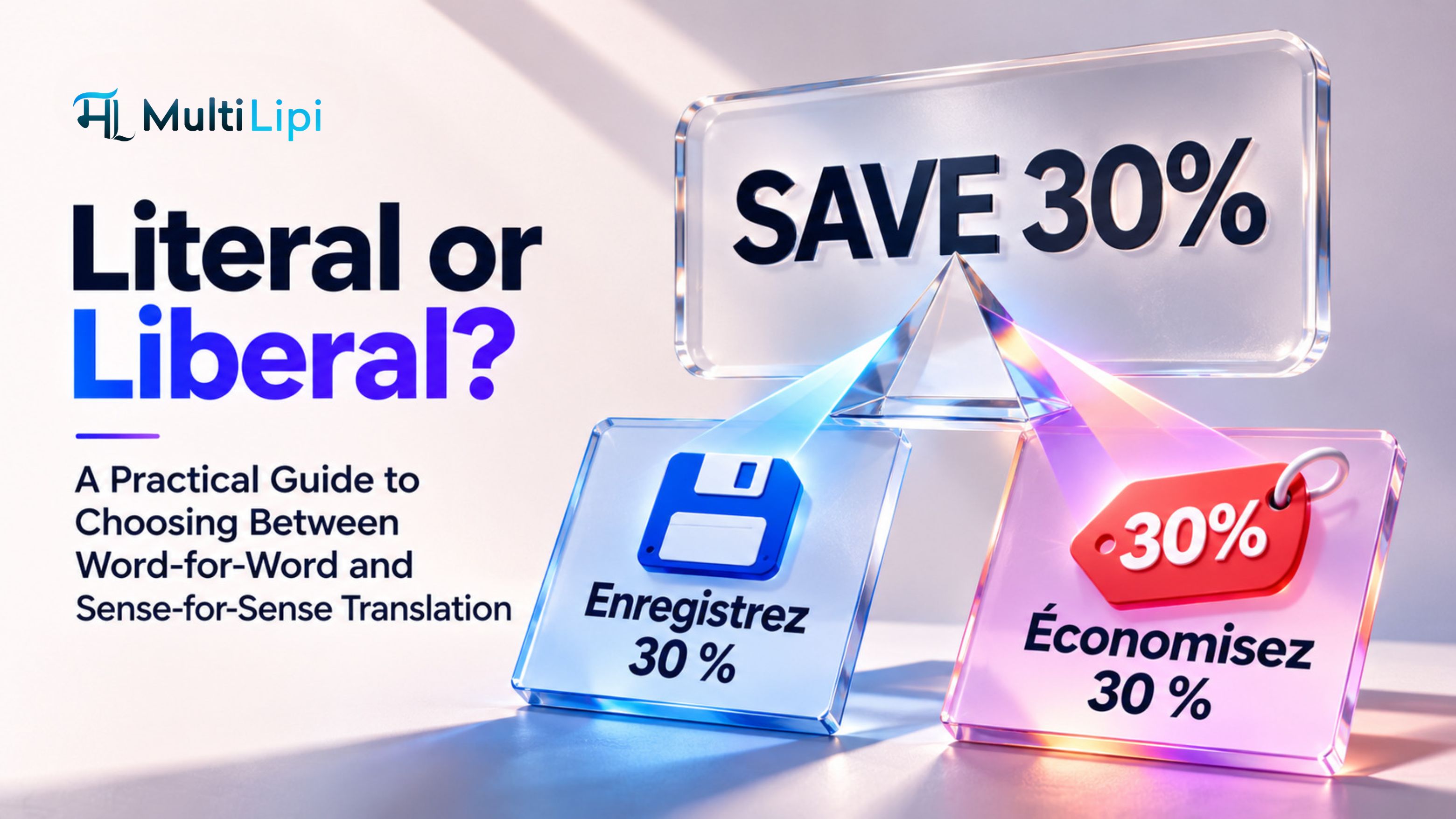
Take the English tagline "Stay ahead of the curve." A word-by-word system may produce a literal version that makes no sense in Vietnamese, Polish, or Japanese.
An AI translator trained with human feedback might suggest "Always one step ahead" or "Lead the trend." It captures intent, not just grammar.
Marketing taglines and brand voice
Brand copy depends on feeling, not only on accuracy. A headline like "Make every market feel like home" is not literally about geography.
A large language model can use your audience, brand voice, and examples to tailor the wording. A human translator then checks meaning, culture, and whether the text sounds natural.
- Machine translation: understandable output that can sound awkward as marketing copy.
- AI translation with context: tailored wording that follows your tone and examples.
- Human review: a final check for emotional meaning and natural phrasing.
The best workflow combines speed, context, and human judgment.
One headline, three useful review questions
Source: “Make every market feel like home.” The exact final translation depends on audience and language.
Which Approach Fits Which Content
The right choice depends on the page, not the technology.
High-volume, low-stakes pages
Some content needs speed and coverage more than polish. Neural machine translation handles it well.
Think of product listings, help articles, internal documentation, and routine website pages. A small stylistic flaw rarely costs you anything.
Spot checks and glossaries still catch recurring errors.
Regulated, brand-critical, and creative content
Other content carries real risk, and that is where human translation earns its cost. A wrong word in a contract can create legal exposure, a mistranslated dosage or consent form can harm a patient, and a clumsy tagline can confuse a customer or weaken your brand. Choose human translators for legal and medical content, where accuracy is non-negotiable, and for marketing, where tone and cultural nuance decide whether a message lands. Save machine translation for low-stakes material like internal notes or quick gist reading.
Send legal contracts, medical documents, and other high-stakes content to professional linguists, since a single mistranslated clause or dosage instruction can carry legal liability or put patients at risk. For lower-risk material, use AI translation with post-editing, and choose fully human translation whenever accuracy, nuance, or regulatory compliance cannot be left to chance.
- Legal terms, contracts, and compliance text.
- Medical, financial, and other sensitive information.
- Brand headlines, taglines, and campaign copy.
- Creative content where humor, emotion, or wordplay matters.
The machine drafts and the human decides. That keeps your cost lower than full manual work.
The best approach for website translation
For a website, a combination wins. Automate the volume, add context where tone matters, and keep people in charge of what your brand cannot afford to get wrong.
The human touch is what turns fast output into translation you can trust.
For international storefronts, run two distinct checks: is the localized text accurate for people, and are any AI-agent-facing actions clear, available and appropriately permissioned? Explore WebMCPly for the agent-action side, while using translation and human-review tools for the language side.
The same content, different quality-control needs
Consider the consequence of an error, not just whether the translation sounds fluent.
FAQ
Is AI translation the same as machine translation?
Not exactly, but they overlap. Modern machine translation already uses AI, because Neural Machine Translation (NMT) runs on neural networks and machine learning.
NMT and LLM translation are both AI-based models under the broad term machine translation.
How does traditional machine translation differ from AI translation?
Traditional systems used rule-based or statistical models. They relied on fixed rules or data patterns.
AI translation uses neural networks that process whole sentences. That gives it more context, and generative AI adds support for tone and instructions.
- Rule-based systems: follow hand-written language rules.
- Statistical models: predict output from patterns in past data.
- Neural and LLM models: read full sentences and adapt wording.
When is human translation better than AI?
Human translation fits regulated, brand-critical, and creative content. A translator checks meaning, culture, and whether the text sounds natural.
That does not mean every human translation beats every machine translation. Quality still depends on the translator, the brief, and the time available.
What is machine translation post-editing (MTPE)?
MTPE is a workflow where a human reviews and corrects an AI draft. The machine produces the first version, and a linguist fixes errors and improves style.
ISO 18587:2017 sets requirements for full human post-editing of machine translation output and the competencies of post-editors.
Which approach is best for website translation?
For websites, a combination works best: fast AI drafts, with human judgment on the pages that matter most. The human touch is what makes the result polished and reliable.
Let AI handle volume and speed. Bring in linguists where brand voice, accuracy, and cultural nuance count.
Conclusion
Machine translation, AI translation, and human translation are not rivals. They are three tools with different jobs.
Neural machine translation gives you speed and scale. LLM-based translation adds tone and instruction-following. Human linguists bring judgment where meaning, cultural nuance, and risk are highest.
For a website, the best answer is a combination:
- Automate high-volume pages to reach more languages quickly.
- Add context and glossaries where your brand voice matters.
- Keep human reviewers in charge of legal, sensitive, and creative copy.
At MultiLipi, we build around this mix: AI-enabled localization with editable translations, so your team can refine what matters most.
Start by sorting your pages by risk. Then match each group to the right level of human involvement. That is how you get fast, consistent, and natural-sounding content in every language you publish.
Explore the related guides and tools
Continue with practical localization resources and, separately, agent-ready website interaction concepts.
- Website translation platform
- Hybrid translation workflows
- Neural machine translation explained
- Machine translation post-editing
- Translation memory
- Translation glossaries
- Visual Editor for translation
- Localizing vs translating a site
- Localization QA checklist
- Multilingual SEO guidance
- Available languages
- Website localization workflow
- WebMCPly: structured browser actions for compatible AI agents